


What It Costs to Move Out Mid-Month (And How to Calculate It Fast)


A move out prorated rent calculator helps you figure out exactly what you owe for a partial month — so you’re not paying for days you’re not living there.
Here’s the quick answer:
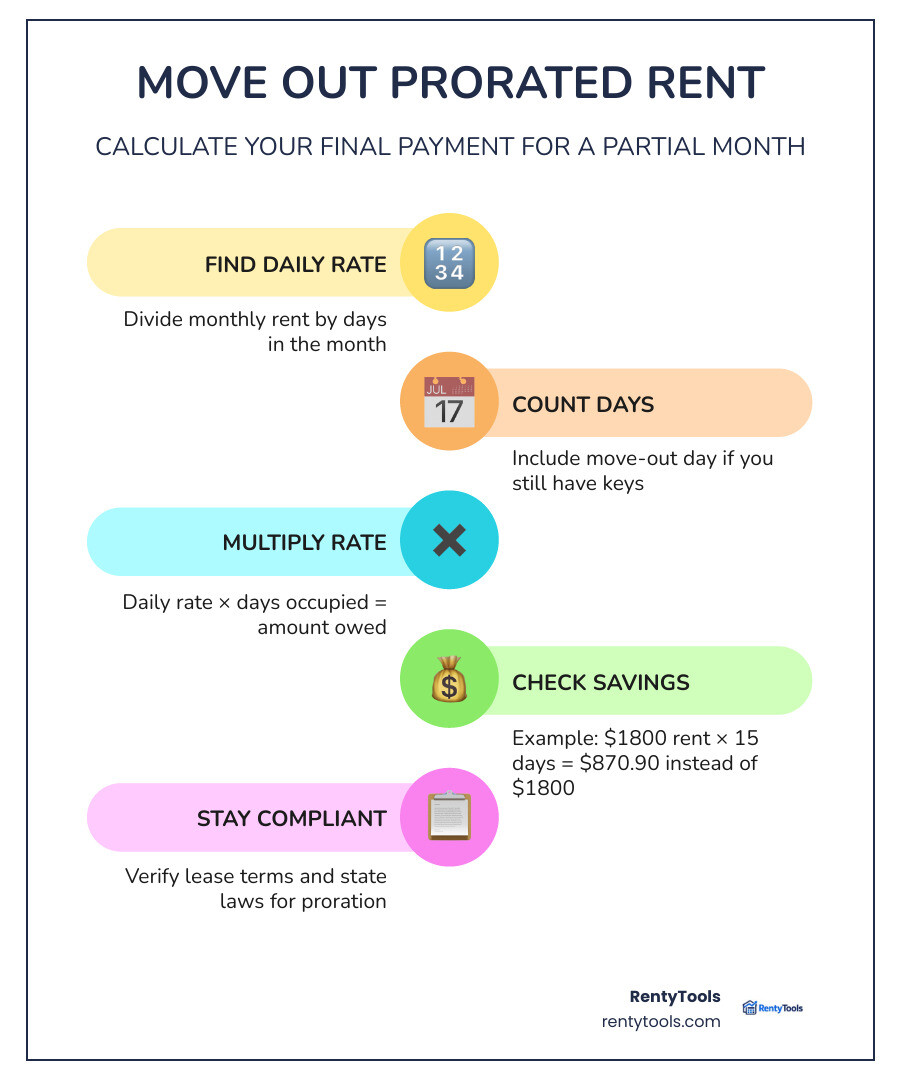
- Divide your monthly rent by the number of days in that month → this is your daily rate
- Count the days you’ll occupy the unit (include your move-out day if you still have keys)
- Multiply your daily rate by the number of days occupied → that’s your prorated rent
Example: Moving out on March 15 with $1,800/month rent:
- $1,800 ÷ 31 days = $58.06/day
- $58.06 × 15 days = $870.90 owed (instead of $1,800)
That’s a savings of over $929 compared to paying the full month.
Most leases run on a clean monthly cycle — but real life rarely does. You might land a new apartment before your current one ends, or a job change forces you out on the 18th. When that happens, paying a full month’s rent for a fraction of the time feels wrong — because it is.
The average U.S. rent sits around $1,987/month, meaning a mid-month move-out could save you close to $993 if rent is properly prorated. That’s not a rounding error — that’s real money.
The math isn’t complicated, but the details matter: which days count, how many days are in the month, and what your lease actually says. Get any of those wrong and you could overpay — or end up in a dispute with your landlord.
This guide walks you through exactly how to calculate your final rent payment, what the law says in your state, and what mistakes to avoid.
What is a Move Out Prorated Rent Calculator?
At its core, a move out prorated rent calculator is a tool designed to ensure financial fairness between a landlord and a tenant. In real estate, “to prorate” simply means to divide something in a proportional way based on time. If you aren’t living in an apartment for the full 31 days of May 2026, why should you pay for the full 31 days?
Our Prorated Rent Calculator takes the guesswork out of this process. It works by taking your total monthly rent and breaking it down into a “daily rate.” Once we know what one day of living in your home costs, we multiply that by the exact number of days you actually occupied the property during your final month.
This creates transparency. Instead of a landlord pulling a number out of thin air, both parties can look at the billing cycle and agree on a figure based on the occupancy period. It’s a win-win: the tenant saves money (typically 30-70% on partial months), and the landlord builds rapport while ensuring the unit is paid for until the keys are handed back.


How to Calculate Prorated Rent When Moving Out
Calculating your final payment doesn’t require a degree in advanced mathematics, but it does require a calendar and a bit of attention to detail. Whether you are moving across town or across the country, the goal is to reach a figure that reflects your actual usage of the space.
When we talk about mid-month transitions, we are usually looking at the number of days from the 1st of the month until your official move-out date. Understanding Why Prorated Rent for the First Month Can Save You Real Money often helps tenants realize that the same logic applies when leaving. If you are looking for more tools to manage your transition, our suite of Rent Calculators can help you stay on top of every dollar.
The Standard Formula for a Move Out Prorated Rent Calculator
While there are a few different ways to slice the pie, the most common and accurate method used by a move out prorated rent calculator is the “Actual Days in Month” method. This accounts for the fact that months vary in length.
The Formula: (Monthly Rent ÷ Total Days in the Month) × Days Occupied = Prorated Rent
To keep things accurate, we recommend rounding your daily rate to four decimal places during the calculation, and then rounding the final total to the nearest cent.
Month LengthMonthly RentDaily Rate10 Days Occupied28 Days (Feb)$2,000$71.4286$714.2930 Days (June)$2,000$66.6667$666.6731 Days (May)$2,000$64.5161$645.16
As you can see, moving out in a 31-day month like May 2026 is slightly “cheaper” per day than moving out in February.
Counting Days for Your Move Out Prorated Rent Calculator
The biggest point of contention between landlords and tenants is usually: Which days count?
Generally, the move-out day is included as a day of occupancy. If you have possession of the keys at 8:00 AM on the 15th, you have occupied the unit for that day. Most landlords use a midnight cutoff. If you haven’t returned the keys and cleared your belongings by the agreed-upon time on your move-out date, you might even be charged for an extra day.
In May 2026, if you move out on the 12th, you would count 12 days of occupancy (the 1st through the 12th inclusive). If you’re planning your next move and want to see how these costs fit into your future budget, check out our Rent Affordability Calculator.


Legal Requirements and State Laws for Proration
Is a landlord legally required to prorate your rent? The answer, frustratingly, is: “It depends.”
Currently, only 3 states have strict laws requiring proration by default. In most of the 50 states plus D.C., the lease agreement is the “law of the land.” If your lease says you owe the full month’s rent regardless of when you leave, you might be stuck paying it unless you can negotiate.
However, certain jurisdictions have specific rules:
- California: California Civil Code often requires proration, especially when a 30-day notice is given mid-month.
- New York: Proration is generally required if proper notice is provided according to state statutes.
- Texas: Proration is standard practice provided a 30-day notice is given, though it is heavily dependent on the specific lease language.
If you are moving out because you are splitting from a roommate situation, it is also helpful to know How to Split Rent Fairly so that the departing person pays only their share of the prorated amount.
Should Landlords Prorate Rent for Tenants Moving Out Mid-Month?
Even if it isn’t strictly required by state law, we believe landlords should prorate rent. Why? Because it builds tenant rapport and promotes fair housing practices.
From a landlord’s perspective, offering a move out prorated rent calculator approach can actually help fill vacancies faster. If a tenant knows they aren’t being “cheated” out of two weeks of rent, they are more likely to provide a clean, timely move-out, allowing the landlord to get a new tenant in sooner. It’s about flexibility and fairness. If a tenant gives a proper written notice, refusing to prorate can lead to unnecessary disputes and negative reviews.
Common Mistakes to Avoid When Prorating Rent
When emotions are high during a move, it’s easy to make a math error or a procedural blunder. Here are the most common pitfalls we see:
- Using a Flat 30-Day Rate: Some landlords use a 30-day average for every month. While simpler, this can cause you to overpay in months like February or underpay in months like May. Always use the actual days in the month for the highest accuracy.
- Violating the Notice Period: This is the big one. If your lease requires a 30-day notice and you give it on the 15th of the month, you are technically responsible for rent for the next 30 days. You can’t just move out on the 20th and refuse to pay the rest if you didn’t give enough lead time.
- Security Deposit Confusion: Never assume you can just “use the security deposit” to cover your final prorated rent. In most states, this is illegal. The security deposit is for damages; rent must be paid separately.
- No Paper Trail: Always get the prorated amount in writing. Send an email saying, “As per our discussion, I am moving out on May 15th. Using the move out prorated rent calculator method, my final payment will be $X.XX. Please confirm.”
- Forgetting the Keys: If you move out but keep the keys for three extra days to “clean,” the landlord can legally charge you for those three days. Your occupancy ends when the keys are in the landlord’s hand.
Frequently Asked Questions about Move-Out Proration
Do I have to pay for the day I move out?
Yes, typically. As long as you have access rights to the unit for any part of that day, it counts as a day of occupancy. If you want to avoid paying for that day, you would need to have everything out and the keys returned by 11:59 PM the night before.
Can a landlord refuse to prorate my final month?
Yes, unless you live in one of the few states that mandate it or your lease specifically allows for it. Many “standard” leases state that rent is due in full on the 1st and is non-refundable. This is why it is vital to negotiate proration before you sign the lease or when you are providing your move-out notice.
How does a leap year affect my prorated rent?
In a leap year, February has 29 days instead of 28. This changes your daily rate. For example, $1,500 rent in a normal February is $53.57/day. In a leap year, it drops to $51.72/day. While 2026 is not a leap year, it’s a crucial detail to remember for future moves!
Conclusion
Moving is stressful enough without worrying about whether you’re being overcharged for your final days in a home. By using a move out prorated rent calculator, you bring a level of professional accuracy to the conversation with your landlord.
At RentyTools, we believe in financial clarity for everyone involved in the rental process. Whether you are a tenant trying to save for your next security deposit or a landlord looking to keep your records straight, our Prorated Rent Calculator is here to help.
Don’t leave your final check to guesswork. Run the numbers, document the date, and move into your next chapter with confidence!