

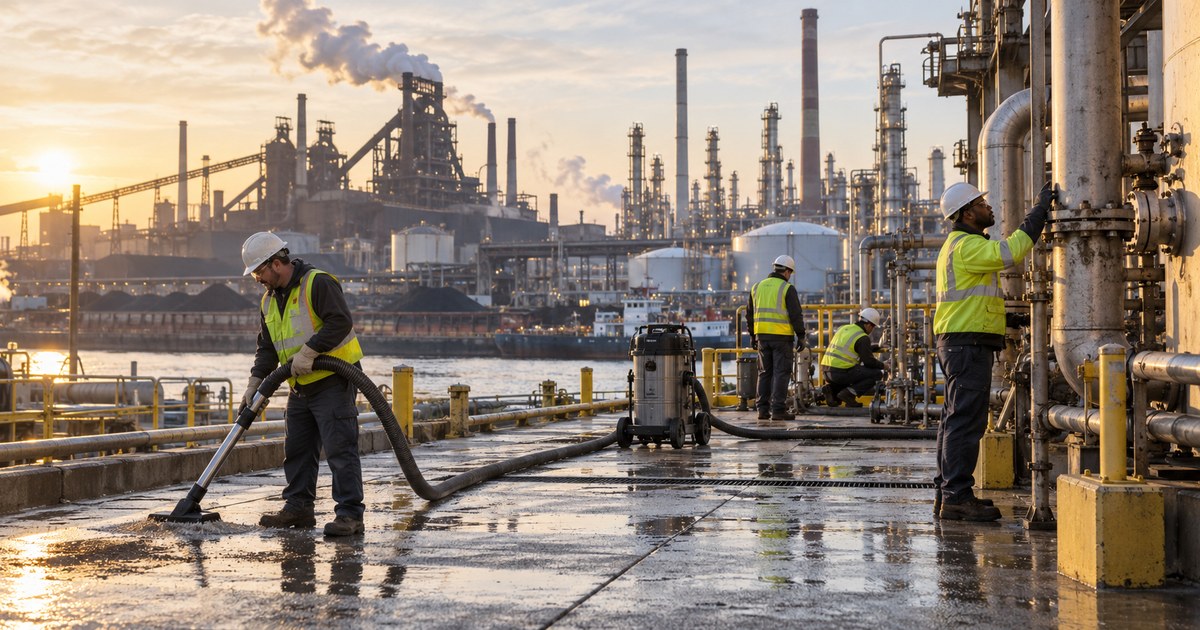
An industrial site rarely has just one cleaning or waste problem. Residue hardens inside process tanks and vessels, sludge settles in sumps and floor drains, grease builds up in traps, spent liquids wait in holding tanks for pickup, and buried lines need clearing without damage. Treating each of these as an unrelated maintenance task can create scheduling gaps, duplicated service visits, and unnecessary downtime.
For plant managers and facility operators across Northwest Indiana, coordinating these services can make maintenance far easier to manage. The goal is not simply to keep surfaces looking clean. It is to control buildup and waste wherever it can affect safety, regulatory compliance, drainage, equipment performance, and daily production.
Industrial Cleaning Is Only One Part of the System
Industrial cleaning removes buildup from equipment and structures that ordinary methods cannot reach, including tank and vessel interiors, process and exhaust ductwork, sumps, and hardened deposits behind machinery. Depending on the material and level of buildup, crews may rely on hydro jetting, vacuum extraction, or manual entry.
Much of this work involves confined spaces, tanks, silos, and pits that can hold hazardous atmospheres or trap a worker. OSHA's permit-required confined space standard addresses atmospheric testing, ventilation, trained attendants, and rescue planning for exactly these conditions. A vessel may look clean from an access hatch while residue remains deeper inside, so operators should ask which parts of the system are included, how difficult-to-reach areas are evaluated, and whether completed work is documented.
Cleaning frequency should reflect how the equipment is used. A high-output line handling oils, coolants, or process sludge accumulates faster than a lower-volume operation. Managers should monitor buildup and follow the requirements that apply to their equipment, insurer, and local jurisdiction.
Coordinating Related Services Reduces Downtime
The process equipment is not the only place where waste causes problems. Grease traps need service before fats, oils, grease, and solids interfere with drainage. Liquid waste and sludge require dependable hauling before storage areas overflow. Buried utilities sometimes need hydro excavation to expose them safely, and floors, containment areas, and hard-to-reach surfaces still need periodic deep cleaning.
When several vendors handle these tasks independently, managers must maintain multiple schedules, invoices, access arrangements, and disposal records. One missed appointment can leave an important part of the plan unaddressed a backed-up trap can create odors and drainage issues even when the process tanks were recently cleaned.
Bundling compatible services can reduce separate appointments and help managers build a more consistent maintenance calendar. Companies such as Tierra Environmental & Industrial provide industrial cleaning alongside grease trap pumping, liquid waste hauling, vacuum truck services, and hydro excavation for commercial and industrial facilities throughout Northwest Indiana and the surrounding Midwest. The main advantage is coordination: a facility can review several needs together, identify overlapping service intervals, and reduce the administrative time spent managing different contractors.
Waste Hauling and Disposal Records Matter
Anything removed from a site tank sludge, contaminated water, spent, liquids becomes waste that someone must transport and dispose of legally. Requirements vary by material and jurisdiction; hazardous waste transporters, for example, must carry a U.S. EPA identification number, while solid waste rules differ locally. The Indiana Department of Environmental Management outlines these distinctions on its waste transportation page, and reliable providers give you manifests that trace each load to a permitted facility.
Scheduling matters too. Facilities should arrange service around production runs, shift changes, and shutdowns, with clear communication about equipment lockout, access, cleanup, and restart times so maintenance does not disrupt normal operations.
Build the Plan Around the Facility
A practical plan begins with an inventory of every piece of waste-producing equipment and every area affected by it. Managers can document tank and vessel cleaning, grease trap pumping, vacuum and liquid waste service, hydro excavation, and general deep cleaning separately while coordinating everything through one calendar.
This approach makes missed services easier to spot and lets schedules flex as production rises or falls. More importantly, it treats industrial cleaning as an ongoing operating system rather than a series of emergency cleanups. For busy Northwest Indiana facilities, that shift can reduce administrative work, limit interruptions, and support a cleaner, safer, and more compliant operation. When licensing or disposal questions come up, confirm them directly with IDEM or your local solid waste district.